Hairpin or Sweeper: Two Corners, Two Different Lines
Hairpin or sweeper: see how corner shape changes entry, apex and exit, and learn what to watch as a driver manages a tight turn or a sustained arc.
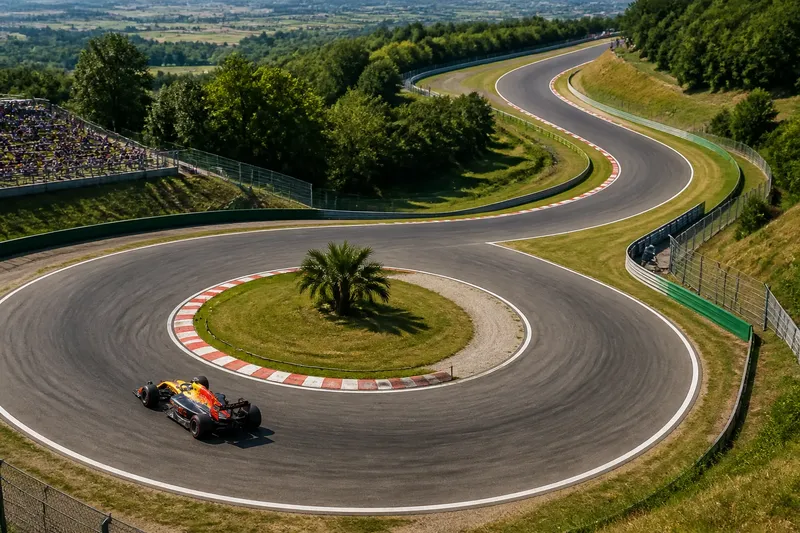
A hairpin compresses braking and turning into a tight rotation; a sweeper spreads the task across a longer curve. Knowing that difference helps explain why the racing line through one corner may look nothing like the line through another.
Why does a hairpin need room to rotate?
A hairpin usually turns through a tight arc and may follow a straight. The driver slows before turning in, then works to bring the car around without asking the front tires to change direction too abruptly.
The approach can look wide from the stands. A driver may use the outside of the track before turning toward the inside, leaving space for the car to rotate. Turning in too early can put the car near the inside curb before it is pointed toward the exit.
At a slow hairpin, getting the car aimed toward the next section can matter more than carrying speed through the middle. Watch the car’s heading as it approaches the apex, then notice how its steering begins to open on the way out.
Follow the car’s direction, not just its distance from the curb.
When does a later apex help?
The apex is the point where a car passes closest to the inside of a corner. In a hairpin, a driver may aim for a later apex, continuing the turn before reaching the inside so the car has room to point toward the exit.
That choice can create a more open path out of the corner, particularly when a straight follows. Curbs, walls, surface changes and nearby traffic can all affect how late a driver can sensibly turn toward the inside.
Imagine a driver approaching a hairpin that leads onto a long straight. The driver brakes while traveling straight, turns toward a later apex, then gradually unwinds the steering as the car leaves the corner. The observable result is a car that turns toward the straight sooner on exit, even if its passage through the middle looks cautious.
Why does a sweeper reward a sustained arc?
A sweeper bends over a longer distance and generally allows more speed through the turn. The driver shapes a continuous curve, balancing steering with the grip available rather than making one sharp change of direction.
The car may stay near the outside for part of the approach, move inward gradually and drift outward as the bend opens. A sudden move toward the apex can use grip needed to keep the car settled through the rest of the curve.
A sweeper’s radius can change, or its surface may include a crest or an awkward inside curb. The car’s path therefore may not trace the curb closely. Watch how its direction changes across the whole bend, rather than treating the nearest point to the inside as the only meaningful moment.
How do entry, apex and exit differ?
Entry is the approach and initial turn-in; the apex is the closest point to the inside; exit is the path away from the corner. A hairpin concentrates slowing and rotation, while a sweeper stretches the turning task across a longer arc.
- Entry: If the corner is a hairpin, look for the driver to slow before turning; if it is a sweeper, look for a composed approach into the continuing curve.
- Apex: If the hairpin leads to a useful exit, a later inside point may leave room to aim the car outward; if the bend is a sweeper, follow how the car approaches and passes the inside over time.
- Exit: If a hairpin opens onto a straight, the driver may prioritize pointing the car along it; if a sweeper continues, the car may still be turning as it moves toward the outer edge.
- Track beyond: If another bend follows immediately, the driver may leave space for that turn; if the track opens out, the exit can use more of the available width.
- Traffic: If another car blocks the usual path, the driver may choose a different entry or apex; if the path clears, the car may return to a more direct line.
- Surface: If a patch of dust, moisture or debris is visible, the driver may avoid it; if the usable surface is clear, that reason for changing the path is absent.
These cues describe possible choices, not a prescription. Read the track beyond the corner as part of the decision.
What do spectators often ask about hairpin or sweeper lines?
Why might a driver turn in later at a hairpin?
A later turn-in can help leave the car better aimed toward the exit, especially when the corner leads onto a straight. The driver still has to account for the curb, available track and any nearby car.
Is the inside curb always the best place to pass?
No. A tight curb can unsettle the car, and a line close to the inside may leave little room to accelerate out. The useful path depends on the corner and the track that follows.
Why can a sweeper have no obvious apex?
Its turn may develop gradually, so the closest point to the inside is less visually dramatic than in a hairpin. A changing radius or a continuous bend can make the whole arc more informative than one point.
Why might the same car take another line on a later lap?
Traffic, a defensive move, a passing attempt or a change in the available surface can alter the driver’s path. A different line alone does not identify which factor mattered.
How can you compare the two corner shapes?
Say you are watching an invented race weekend with one hairpin feeding a straight and one long sweeper. At the hairpin, you note that a driver brakes before turn-in, passes the inside later and opens the steering toward the straight; at the sweeper, the same driver follows a continuous curve without a sharp pivot. The result is a clear distinction in the work each corner asks for, without assuming that either line is ideal for every car or lap.
For a useful comparison, choose one feature—such as when the car begins to turn—and follow it through both corners. That keeps the corner shape in focus without turning a single pass into a verdict on the driver.
What should the corner shape tell you?
A hairpin concentrates braking and rotation; a sweeper demands a composed arc that continues through the bend. The distinction is a starting point for reading racing lines, not a rule that overrides the car, conditions or what lies beyond the corner.
The search phrase “hairpin or sweeper” describes a useful comparison, but the next section of track often explains the driver’s choice. Look past the apex to see whether the car is being positioned for a straight, another turn or a clear route around traffic.