Why Racing Cars Use Different Wing Angles
Why racing cars use different wing angles shapes cornering grip and straight-line speed; learn how circuit layout and race demands guide the compromise.
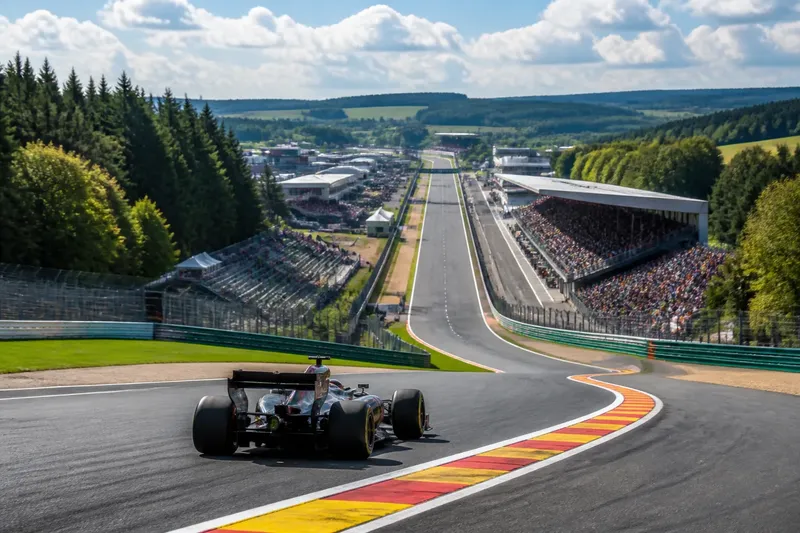
Why racing cars use different wing angles comes down to how a team balances cornering support against drag. A steeper rear wing can help a car stay composed through a fast bend, while a shallower setting can let it accelerate more freely along a straight.
Neither choice is automatically faster. Teams weigh the demands of the whole lap, the car’s aerodynamic balance and its task in the race; a broadcast view shows only part of that decision.
What does changing wing angle do?
A wing shapes airflow to create aerodynamic load, commonly called downforce. That load presses the car toward the track and can help its tyres produce grip in fast corners.
Increasing the wing angle generally increases both aerodynamic load and drag. The added support can help through turns, but the extra resistance can limit acceleration or top speed on a straight. Reducing the angle generally lowers both effects, trading some cornering support for less drag.
The wing works as part of an aerodynamic system, alongside the car’s other surfaces. Its contribution also depends on the conditions around the car, so the angle alone cannot explain every change in handling.
How does the circuit shape the choice?
Long straights make drag more costly, while a layout with sustained fast corners can reward additional aerodynamic support. Most circuits mix both, so teams judge the compromise across a lap rather than choosing a setting for one conspicuous section.
Race circumstances matter too. A driver trying to pass or defend may value straight-line speed differently from one focused on maintaining pace through a sequence of corners. Following another car can also disturb airflow and alter how much support the wings provide.
Imagine a team preparing for a circuit with a long straight and a demanding fast bend. It considers a lower rear-wing angle to help its driver defend on the straight, then checks whether the car can still hold a stable line through the bend. The trade-off is clear: if cornering becomes too difficult, the straight-line advantage may not serve the race plan.
What can you observe during a race?
Compare connected parts of the lap. A car that exits a corner well but loses ground along the straight presents a different pattern from one that is already struggling before it reaches full acceleration.
- Check whether the car gains or loses ground on a clear straight; if it loses ground despite a strong corner exit, consider drag or another straight-line factor, then compare further laps before judging.
- Check whether the driver holds a steady line through fast corners; if the car repeatedly needs corrections, consider reduced aerodynamic support or a balance issue, while allowing for traffic and wind as alternatives.
- Check how the car exits the corner before the straight; if it accelerates slowly from the exit, look at cornering behavior as well as drag, rather than treating the straight-line gap as a wing clue alone.
- Check whether the pattern repeats in comparable parts of the circuit; if it appears repeatedly, treat a setup explanation as more plausible, but if it occurs once, allow for a local incident or changing conditions.
- Check whether the car is in another vehicle’s wake; if it is, account for disturbed airflow, while comparing a clean-air passage before drawing a broader conclusion.
- Check whether the comparison involves cars with similar race tasks and circumstances; if they differ, avoid reading the gap as a direct setup comparison and use each car’s behavior across its own lap instead.
These observations can help explain the compromise without revealing an exact wing setting. Engine deployment, tyres, fuel load, traffic and driver choices may also shape what appears on screen.
Why might a car feel unsettled in fast corners?
Reducing rear-wing support can make the back of a car feel less secure in fast turns. But a driver’s difficulty holding a line does not identify the wing angle on its own: the balance between front and rear aerodynamic support, mechanical grip and the airflow around the car also matters.
Notice where the movement occurs. A problem at turn-in may look different from one that appears mid-corner or when the driver applies power on exit. Repeated behavior in similar corners is more informative than one twitch, especially if the car is running in traffic or facing gusty wind.
What do spectators often ask about wing angles?
Does a bigger wing always create more downforce?
A larger or more steeply set wing can generally contribute more aerodynamic load, but its effect depends on its design and how it works with the rest of the car. Its appearance alone does not reveal the full aerodynamic setup.
Why not use the lowest angle everywhere?
A lower angle can reduce drag, but it also reduces the wing’s contribution to cornering support. If the driver loses too much stability or speed through corners, the straight-line benefit may not compensate across the lap.
Why not use the highest angle everywhere?
A higher angle can support the car in fast corners, but the added drag can cost speed on straights. Teams seek a circuit-wide compromise rather than maximizing one quality at every point.
Can spectators tell the exact wing setting from television?
Usually not. A camera may show the wing’s shape, but not reliably reveal its precise angle or the rest of the car’s setup; behavior across straights and corners offers a more useful, though still incomplete, picture.
How should you interpret a wing-angle clue?
Start with a specific sequence: the corner before a straight, the car’s exit, and its progress along the straight. That gives you a way to compare cornering support with straight-line resistance without treating either symptom as proof of a particular setting.
Why racing cars use different wing angles becomes easier to understand when you follow that sequence. The wing can aid a fast corner and impose a cost afterward, while the best compromise depends on the circuit and what the driver needs to do.
When watching, choose one fast corner and the straight that follows it. If the car gains ground through the turn but loses it on the straight, you can see the competing demands at work—even though the broadcast cannot tell you the exact setup choice.