The Safety Car, from Course Car to Race Tool
Learn how the safety car manages hazards, how its procedures differ from a virtual safety car, and what signals reveal before racing resumes.
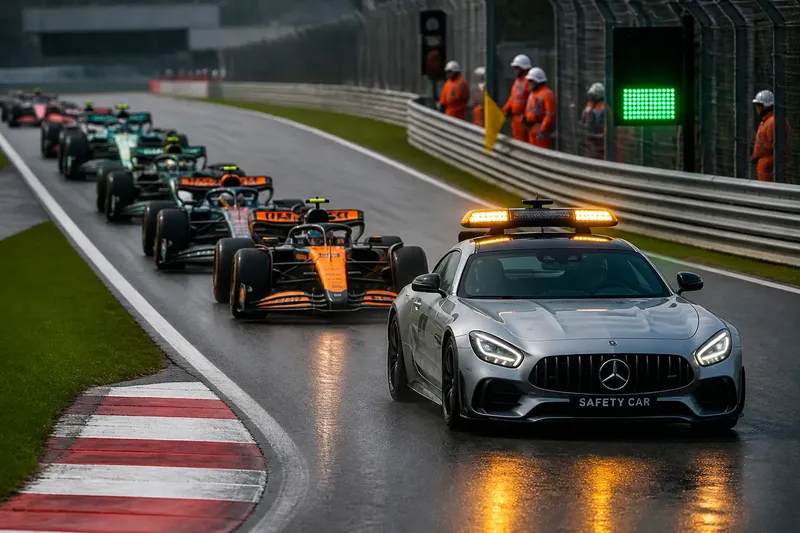
A safety car changes what a race asks of its drivers: instead of choosing their own pace, they follow race-control instructions while a hazard is managed. The safety car can also compress the gaps between competitors, so understanding the procedure helps explain why the field may look different when racing resumes.
How did the safety car become a race-control tool?
Early motor races sometimes used a course car to lead competitors at a start or guide them along a course. That broad description covers different practices, not one uniform procedure, and it should not be confused with today’s race-neutralizing safety car.
Modern safety-car procedures address a specific problem during competition: traffic must slow while officials assess or clear a hazard. A damaged car, debris, or work by marshals near the track can make racing speed unsafe. The safety car gives competitors a visible vehicle to follow while race control manages the response.
Procedures differ by championship and can change over time. For a particular event, the series regulations and race-control messages are more reliable than assumptions drawn from another racing category.
What does a neutralized race mean?
During a neutralized period, the race may continue under its rules, but drivers cannot race freely for position. They follow the prescribed pace and signals, and overtaking is restricted except where the regulations or race control allow it.
The order and the gaps are separate things. A driver can keep the same position while losing much of the time cushion built before the safety car appeared; the incident response, not a fresh contest between cars, is what changes the spacing.
How does a physical safety car affect the field?
A physical safety car joins the circuit and leads the field according to the event’s procedure. Drivers slow, form a queue, and may close the distance to cars ahead. The leader’s previous advantage can shrink, while the running order may remain largely intact.
Rules determine details such as whether lapped cars may pass the safety car and where they rejoin. Race control also communicates when the queue should form and when the controlled period is ending. Those instructions matter more than a general expectation about how every championship handles the same situation.
Imagine a leader has built a clear gap when debris is reported on a fast section. Race control deploys the safety car, and the field follows while marshals clear the debris. If the leader remains first, the observable result is that the advantage over the next car is smaller at the restart; the leader retains track position but has less room to respond to a rival’s launch.
How does a virtual safety car differ?
A virtual safety car, where used, requires drivers to reduce speed under prescribed signals or timing limits without placing a vehicle ahead of the field. Cars generally remain distributed around the circuit rather than collecting in one queue, so their gaps need not contract in the same way.
A local yellow flag warns drivers about a hazard in a particular section and calls for caution there. A red flag is a separate control that stops the session or race under the series’ rules. These signals and procedures are not interchangeable; follow the event’s instructions to understand which one is active.
What should you watch during a safety car period?
Track the sequence of signals and actions, not just the tighter spacing. Each observation can help explain whether the hazard response is continuing or the return to racing is approaching.
- Safety-car entry: Check where the car joins and whether the leader is already ahead of the entry point; if the leader is ahead, follow the event’s instructions for how the field is collected, and if not, watch for the leader to join the queue.
- Queue formation: Check whether cars are catching the line and reducing gaps; if the field remains spread out, allow for cars still approaching or a different procedure rather than assuming racing has resumed.
- Marshal activity: Check whether debris is being removed or a car is being attended to; if work remains near the circuit, expect the controlled period to continue, and if the area is clear, wait for an official signal before treating it as over.
- Trackside signals: Check lights, flags, and race-control messages; if they maintain the neutralization, drivers must continue to follow instructions, and if they indicate a restart procedure, watch for the event’s stated conditions.
- Passing rules: Check whether race control has authorized lapped cars to pass; if it has, note which cars move and where they rejoin, and if it has not, do not infer that a car’s movement is a general permission to overtake.
- Return to racing: Check the signal that ends the controlled period and the order as the field accelerates; if passing remains restricted, keep treating the group as neutralized, and if racing is declared, compare the positions as overtaking becomes permitted.
Use the series’ signals to read the situation: a close queue may reflect controlled running, while a change in the official instructions tells you when the race returns to competition.
What do viewers often ask about the safety car?
Does the safety car stop the race clock?
Not necessarily; timing depends on the event’s rules and the type of interruption. Check the championship regulations or official timing information rather than assuming that a safety-car period pauses the clock.
Can drivers overtake behind the safety car?
Overtaking is generally restricted, with exceptions defined by the series or race-control instructions. Follow the active signals, since permission for a particular movement does not automatically allow all cars to pass.
Who decides when the safety car returns to the pit lane?
Race control manages the procedure under the applicable regulations. Drivers respond to its signals and instructions rather than individually deciding that the neutralized period has ended.
Why can the restart be difficult?
Cars restart in close proximity, leaving less room to respond to a slow launch or a change of line. The exact procedure and permitted actions depend on the series, so watch for its restart signal and instructions.
Why does the safety car matter to the race?
The safety car serves a practical purpose: it controls traffic while officials address a hazard. Its effect on the contest follows from that procedure, because drivers may return to racing with less separation than they had before the interruption.
For the next race, keep an eye on both the hazard response and the official signals. The safety car’s return to the pit lane is only one part of the transition; the instructions that follow determine when the drivers may race freely again.